
Preparing a Volvo for winter driving requires testing the 12-volt battery, inspecting tire tread depth, setting cold-weather tire inflation, refilling the washer reservoir with sub-zero rated de-icing fluid, and confirming all exterior lighting and defrosters operate correctly. Completing these checks before sustained sub-freezing temperatures arrive prevents starting failures, preserves electronic safety sensor visibility, and ensures that the all-wheel-drive system delivers maximum traction across slush, packed snow, and black ice.
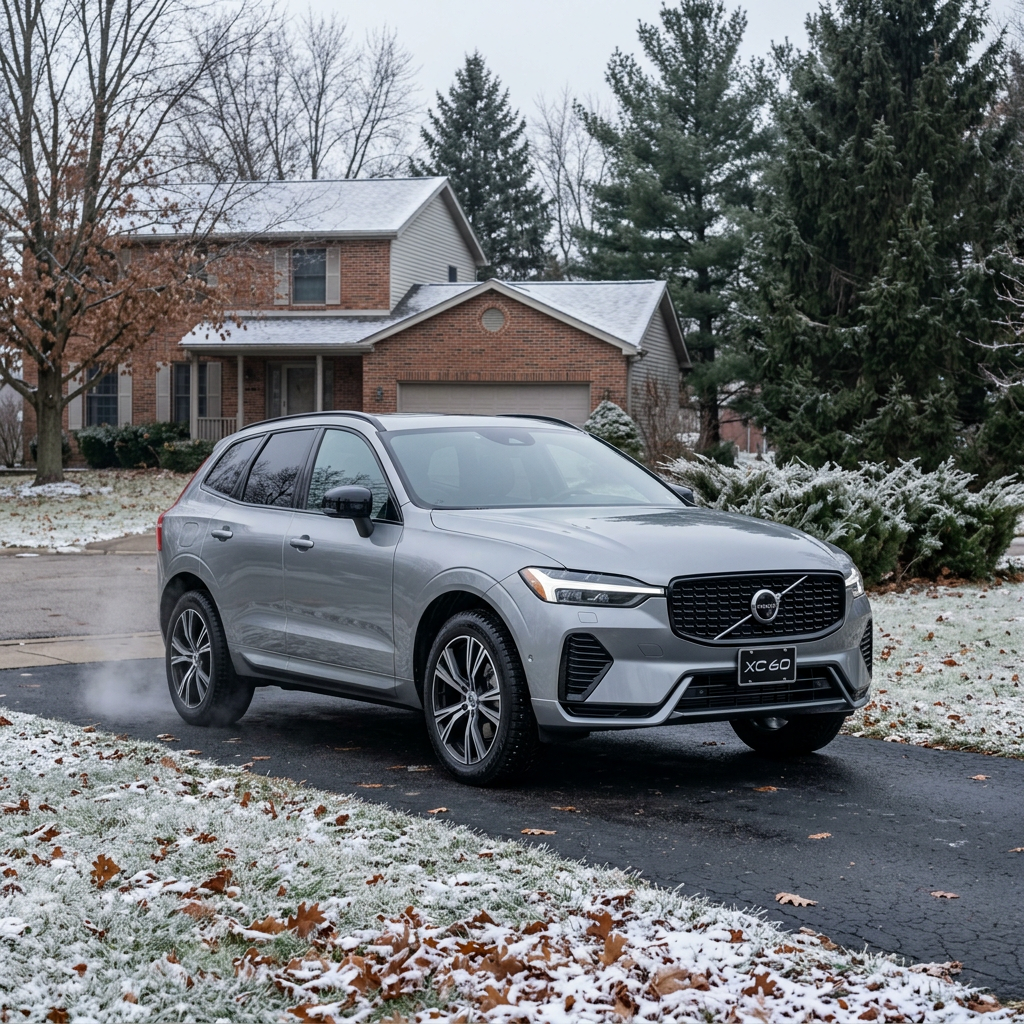
Cold weather places severe mechanical demands on every vehicle system. Engine oil thickens at low temperatures, requiring more electrical current to turn over internal combustion engines like the 2.0L turbocharged 4-cylinder found in models such as the 2026 Volvo XC60. At the same time, road salt and slush coat windshields, headlamp lenses, and radar sensors, making clear outward visibility and functional driver aids essential. Drivers navigating icy stretches near the St. Joseph River in Fort Wayne regularly encounter sudden shifts between treated pavement and packed river valley frost, where compromised tires or weak batteries quickly lead to roadside delays.
Our service team follows a factory-specified winter inspection protocol designed specifically for Scandinavian engineering:
- Battery Health and Starting Capacity: Testing cold cranking amps and reserve capacity on the 12-volt starter battery, along with terminal cleaning to prevent voltage drops.
- Tire Inspection and Pressure Calibration: Verifying tread depth exceeds the four-millimeter threshold recommended for winter driving, checking sidewalls for damage, and resetting the internal tire pressure monitoring system.
- Fluid and Anti-Freeze Verification: Testing engine coolant concentration to ensure freeze protection down to minus 35 degrees Fahrenheit, alongside checking brake fluid moisture levels.
- Wiper and Washer System Check: Replacing worn wiper rubber with beam-style synthetic blades and testing the heated washer nozzle elements.
- Climate and Defroster Operation: Inspecting the cabin air filter to ensure unobstructed airflow for rapid windshield defogging, and confirming heated seat and steering wheel performance.
To have our technicians inspect your vehicle before severe weather arrives, you can navigate directly to our showroom using our Fort Wayne location map or reach our service desk directly by calling (260) 454-8569.
Table of Contents
- How Does Cold Weather Affect Your Volvo Battery and Range?
- How Do Cold Temperatures Affect Volvo Tires and TPMS Calibration?
- How Does Volvo AWD Winter Handling Compare to Audi quattro and Subaru Symmetrical AWD?
- Which Volvo SUV Is Best for Severe Snow and What Belongs in Your Winter Kit?
- What Volvo Winter Maintenance Should You Check Before Cold Weather?
- Common Questions About Volvo Winter Preparation
- Winterizing Your Volvo at Tom Kelley Volvo Cars
How Does Cold Weather Affect Your Volvo Battery and Range?
Freezing temperatures reduce battery capacity by slowing internal electrochemical reactions, which can sap up to 50 percent of a conventional 12-volt battery's cranking power at zero degrees Fahrenheit while increasing electrical draw from heaters, defrosters, and seat warmers. In electrified models, cold ambient air temporarily reduces driving range between 15% and 30% on the coldest winter days because energy from the high-voltage battery must actively warm both the cabin and the battery pack itself.
The dual-battery architecture in modern Volvo vehicles separates starting duties from auxiliary electronic loads. The primary 12-volt battery powers the starter motor on mild-hybrid powertrains, while an auxiliary battery supports active safety computers, infotainment displays, and the City Safety radar array. When temperatures drop below freezing, internal chemical resistance increases in lead-acid and lithium-based cells alike. A weak auxiliary battery can trigger false electronic fault warnings on the instrument cluster, while a degraded starter battery may struggle to turn over the engine during a cold morning start.
For plug-in hybrid and pure electric models, winter range reduction stems primarily from thermal management requirements rather than permanent cell degradation. Electric propulsion produces virtually no waste heat, meaning cabin warmth must be generated electronically via high-voltage PTC heaters or heat pumps. Running the cabin heater at maximum output while driving draws continuous power straight from the traction battery.
Pre-heating the cabin solves this challenge. Drivers can activate remote climate pre-conditioning through the Volvo Cars app while the vehicle remains plugged into a home Level 2 charging station. This process brings the cabin to a comfortable 72 degrees Fahrenheit and warms the high-voltage battery to its optimal operating temperature using grid electricity, preserving the full battery charge for the road. On new vehicle purchases, remote pre-heating and engine start features in the Volvo Cars app may be included; contact the dealership for current subscription details.
If you are considering upgrading to an all-weather luxury crossover engineered for extreme climates, browse our new Volvo SUV inventory to explore models with integrated winter thermal management.
How Do Cold Temperatures Affect Volvo Tires and TPMS Calibration?
Tire pressure drops approximately one to two pounds per square inch for every 10-degree drop in ambient temperature, causing the tire pressure warning light to illuminate on cold mornings even when tires have no physical punctures. Maintaining proper tire inflation is critical during winter because underinflated tires flex excessively, reducing steering precision, lengthening braking distances on slick snow, and accelerating uneven shoulder wear.
Volvo vehicles utilize an Indirect Tire Pressure Monitoring System ( iTPMS). Rather than using fragile pressure sensors mounted inside each wheel valve stem, the system relies on the vehicle's anti-lock brake wheel speed sensors to measure the rotational speed of each rolling tire. A tire with lower pressure has a smaller rolling circumference and therefore rotates faster than a properly inflated tire. Because this calculation depends on relative rotational speed, the system must be recalibrated whenever tire pressures are adjusted, tires are rotated, or seasonal winter tires are mounted.
Calibrating the tire pressure monitoring system follows a straightforward, in-cabin sequence:
- Park the vehicle on a level surface and allow the tires to cool completely.
- Inflate all four tires to the factory cold inflation pressures listed on the driver-side B-pillar door jamb label.
- Start the vehicle and access the center touchscreen display.
- Tap the Settings icon or open the Car Status application from the app screen.
- Select TPMS or Status, then press the Store Pressure or Calibrate button.
- Confirm the prompt on the screen.
- Drive the vehicle at steady speeds above 20 mph for 10 to 15 minutes to allow the central module to store the new baseline rotational values.
Winter tires feature specialized hydrophilic rubber compounds that remain flexible below 45 degrees Fahrenheit, alongside deep directional sipes that bite into hard-packed snow and ice. While standard all-season tires harden into rigid plastic-like rubber in freezing temperatures, dedicated winter tires provide significantly shorter stopping distances.
Drivers seeking comprehensive vehicle readiness can book a battery and tire diagnostic inspection at our service center, or look through our featured pre-owned inventory for all-wheel-drive winter options.
How Does Volvo AWD Winter Handling Compare to Audi quattro and Subaru Symmetrical AWD?
Volvo electronic all-wheel drive delivers seamless winter stability and predictive traction by routing torque instantly to the axle with the most grip through an electro-hydraulic coupling or rear-mounted electric motor, matching the all-weather confidence of mechanical systems while prioritizing passenger comfort and directional control. While Audi quattro and Subaru Symmetrical AWD use permanently engaged mechanical center differentials or multi-plate clutch setups, Volvo integrates traction management directly with Electronic Stability Control to eliminate slip before it disrupts vehicle momentum.
Subaru Symmetrical AWD operates with a continuous, mechanically centered power split that provides tenacious linear pull through deep unplowed snow, making it popular for unpaved backroads. However, its mechanical layout creates noticeable drivetrain drag during dry highway cruising. Audi quattro—specifically the modern quattro with ultra technology—disconnects the rear axle during steady cruising for efficiency and re-engages via electronic multi-plate clutches when front slip is detected.
Volvo's modern AWD architecture approaches winter traction with a dual-focus strategy:
- Instantaneous Torque Transfer: On mild-hybrid models like the XC60 and XC90, the electronically controlled rear coupling pre-charges hydraulic pressure at a standstill, guaranteeing an immediate 50/50 front-to-rear torque distribution upon takeoff on ice to prevent initial wheel spin.
- Electric Rear Axle (e-AWD): Plug-in hybrid models utilize an independent electric motor mounted directly on the rear axle. Because this motor has no mechanical driveshaft linking it to the front gasoline engine, it delivers peak torque to the rear wheels in milliseconds without mechanical latency.
- Winter and Off-Road Driving Modes: Selecting Off-Road mode on compatible models calibrates throttle response to prevent sudden torque spikes, locks the front-to-rear torque split for consistent crawl capability through heavy slush, and activates Hill Descent Control for controlled descents down steep, icy grades.
This electronic integration delivers a refined driving experience that prevents oversteer and understeer without jarring drivetrain clunks, keeping the vehicle stable across variable winter road conditions.
Drivers searching for dependable all-weather capability with verified vehicle history can review our Certified by Volvo vehicles, which include factory warranty backing and rigorous multi-point mechanical inspections.
Which Volvo SUV Is Best for Severe Snow and What Belongs in Your Winter Kit?
The Volvo XC90 represents the pinnacle of severe winter capability within the lineup thanks to its standard all-wheel drive, generous 8 inches of factory ground clearance, and an available four-corner air suspension system capable of raising ride height for deep snow drifts. The midsize XC60 offers comparable all-weather security with a 3,500-pound towing capacity and balanced proportions, while the compact XC40 provides agile handling and responsive winter maneuvering for urban streets.
Deep snow demands physical clearance beneath the chassis. Vehicles with low front splitters push packed snow like a plow, which packs ice into radiator grilles and lifts driving wheels off the ground. The XC90 rides high enough to clear snow berms left by street plows, while its long wheelbase provides exceptional directional stability when crossing highway slush ruts. Suburban commuters traveling east toward New Haven regularly face unplowed residential connectors where elevated ground clearance and balanced electronic torque transfer prevent high-centering.
Even with advanced all-wheel drive, carrying a well-equipped emergency winter kit is essential when severe blizzards strike. Every winter vehicle kit should contain:
- Jumper cables or a compact lithium-ion jump-pack booster.
- Heavy-duty brass-blade ice scraper and telescoping snow brush.
- Folding metal shovel and traction recovery mats or a bag of coarse sand.
- High-visibility safety vest and an LED flashlight with extra lithium batteries.
- Thermal foil space blankets, wool blankets, and insulated waterproof winter gloves.
- Non-perishable energy bars, bottled water kept in an insulated container, and a portable phone power bank.
- Compact first-aid supplies and high-output roadside emergency flares or reflective warning triangles.
If your vehicle suffers an unexpected mechanical disablement, flat tire, or off-road slide during winter storms, do not risk attempting hazardous roadside repairs in freezing conditions. Contact Volvo Roadside Assistance: 1-800-638-6586 for 24/7 manufacturer-backed emergency dispatch, vehicle winching, battery jump-starts, and authorized transport directly to our certified repair center.
If you are planning to transition into a capable luxury SUV this season, you can easily sell your current vehicle to our dealership and apply its value toward an all-wheel-drive model.
What Volvo Winter Maintenance Should You Check Before Cold Weather?
Essential cold-weather maintenance includes checking wiper blade integrity, filling windshield washer fluid with a de-icing solution rated down to minus 20 degrees Fahrenheit, testing engine coolant concentration, and inspecting braking hardware for corrosion or pad thinning. Addressing these wear items before winter sets in ensures optimal forward visibility, maintains engine operating temperatures, and preserves short stopping distances on slick road surfaces.
Windshield visibility is your primary defense against winter hazards. Standard wiper blades often feature exposed metal joints that pack with freezing rain, preventing the rubber edge from contacting the curved glass profile. Volvo models utilize beam-style wiper blades that eliminate external pivot hinges, maintaining uniform downward pressure across the glass. On models like the XC90, washer fluid nozzles are built directly into the wiper arms and feature internal heating elements. This integrated system sprays heated fluid ahead of the wiping edge without atomizing fluid into a freezing mist, preventing clogged nozzles and clearing frozen road grime instantly.
Braking systems also endure extreme punishment during winter months. Heavy municipal salt use accelerates surface corrosion on exposed brake rotors and caliper slide pins, which can cause premature pad drag or uneven brake wear. Our technicians thoroughly inspect rotor thickness, pad friction material, and caliper seals during pre-winter service.
Engine cooling systems require specific attention as well. Coolant does not merely prevent overheating in summer; its ethylene glycol formulation prevents the engine block and radiator from cracking when parked in sub-zero weather. A 50/50 mixture of genuine Volvo coolant and distilled water provides dependable protection against freezing down to minus 35 degrees Fahrenheit while lubricating the water pump seal.
For owners of 2026 gasoline, mild-hybrid, and plug-in hybrid models, Volvo's complimentary factory-scheduled maintenance covers your first two services according to the factory maintenance schedule, ensuring critical mechanical inspections occur at exact factory intervals.
When you are ready to explore your purchase options for an all-weather luxury vehicle, you can submit a credit application online with our finance team to get pre-approved before your visit.
Common Questions About Volvo Winter Preparation
Q: Can I use hot water to de-ice my Volvo windshield?
Pouring hot or boiling water onto a frozen windshield can instantly crack or shatter the automotive safety glass due to extreme thermal shock. The sudden, localized temperature differential causes rapid thermal expansion that compromises the windshield structure. The safest method to clear heavy ice is running your vehicle's engine, engaging the maximum windshield defroster setting, and using a heavy-duty automotive ice scraper alongside winter-grade de-icing spray. Volvo models equipped with heated front windshields use microscopic electrical filaments embedded between the glass layers to melt frost quickly and evenly without risk of glass fractures.
Q: How does road salt affect the undercarriage of a Volvo?
Winter road salt and liquid chemical de-icers accelerate electrochemical oxidation on exposed metallic suspension arms, brake lines, fasteners, and exhaust heat shields. Over multiple winter seasons, brine residue clings to the chassis, promoting rust and deteriorating rubber bushings. While Volvo engineers vehicle platforms with extensive hot-dip galvanized steel, zinc coatings, and full-coverage composite aerodynamic underbody panels, regular undercarriage rinsing is essential. Washing your vehicle every two weeks during winter—particularly using a wash bay with a dedicated high-pressure underbody flush—removes accumulated salt deposits before corrosion can gain a foothold.
Q: Do I need winter tires if my Volvo has all-wheel drive?
All-wheel drive assists with vehicle acceleration and straight-line traction on slippery surfaces, but it does not assist with steering responsiveness or braking distances on packed snow and ice. All four wheels brake identically on all passenger vehicles regardless of drivetrain configuration. Standard all-season rubber tread hardens below 45 degrees Fahrenheit, dramatically reducing mechanical grip. Dedicated winter tires utilize flexible silica compounds and micro-sipes that cut through surface moisture to bite into snow, cutting stopping distances by up to 30 percent compared to all-season tires on hard-packed ice.
Q: How long can I run the remote climate pre-conditioning?
Remote climate pre-conditioning through the Volvo Cars app runs for a standard cycle of 15 minutes before automatically shutting down to preserve energy and prevent unnecessary battery drain. If additional cabin warming or glass defrosting is required in extreme cold, you can initiate a second consecutive 15-minute cycle directly from the mobile app. On plug-in hybrid and pure electric models, pre-conditioning functions best while connected to a home Level 2 charger, ensuring your cabin reaches 72 degrees Fahrenheit while leaving the high-voltage battery at a full 100 percent state of charge for your commute.
Q: Why does my Volvo hybrid start the gasoline engine when it is freezing outside?
Plug-in hybrid Volvo models may temporarily engage the internal combustion engine in freezing weather, even when set to Pure electric driving mode, to protect the powertrain and generate necessary cabin heat. Extremely cold ambient temperatures reduce the maximum discharge rate of the lithium-ion traction battery pack. Starting the gasoline engine allows the vehicle to safely meet high cabin heating demands, circulate warm engine coolant through the heater core, and gently bring the high-voltage battery up to its optimal operating temperature range before transitioning back into pure electric propulsion.
Winterizing Your Volvo at Tom Kelley Volvo Cars
Seasonal winter maintenance protects your investment, preserves critical electronic safety systems, and ensures your vehicle starts reliably regardless of how low the temperature falls. From battery load testing and brake inspections to mounting dedicated winter wheel assemblies and replacing wiper blades, proactive care eliminates cold-weather surprises.
Our certified technicians work with factory diagnostic equipment, genuine fluids, and components engineered to exact Scandinavian standards. Whether you need your auxiliary battery tested, your tire pressure monitoring system recalibrated, or a fresh set of beam wiper blades installed, our team provides comprehensive winter service tailored to your exact model.
To order factory-approved cold-weather accessories, rubber floor trays, or winter wheel packages, you can request components through our parts department. When you are ready for seasonal service, drive to our service center at 865 Grand Nat'l Dr, Fort Wayne, IN 46804 or connect with our service advisors directly at (260) 454-8569 to schedule your winter maintenance appointment.
© 2026 Tom Kelley Volvo Cars. All rights reserved.